


Is It Lowball Season in Laguna Niguel? How Offers Are Actually Getting Accepted This Fall (2026)
Hey neighbors, on paper this fall makes a strong case for writing a low offer. Orange County listings now take an average of 122 days to go pending, the longest stretch since January 2019, according to Steven Thomas's latest Orange County Housing Report. Buyer demand just posted its slowest October since 2007. Nationally, the pending home sales index had its weakest September since tracking began in 2001. If you're shopping right now, it's fair to wonder whether this is the moment to come in 10% under and see what happens.
I understand the logic. It just doesn't hold up once you look at who is sitting on the other side of the table.
Who is actually selling right now
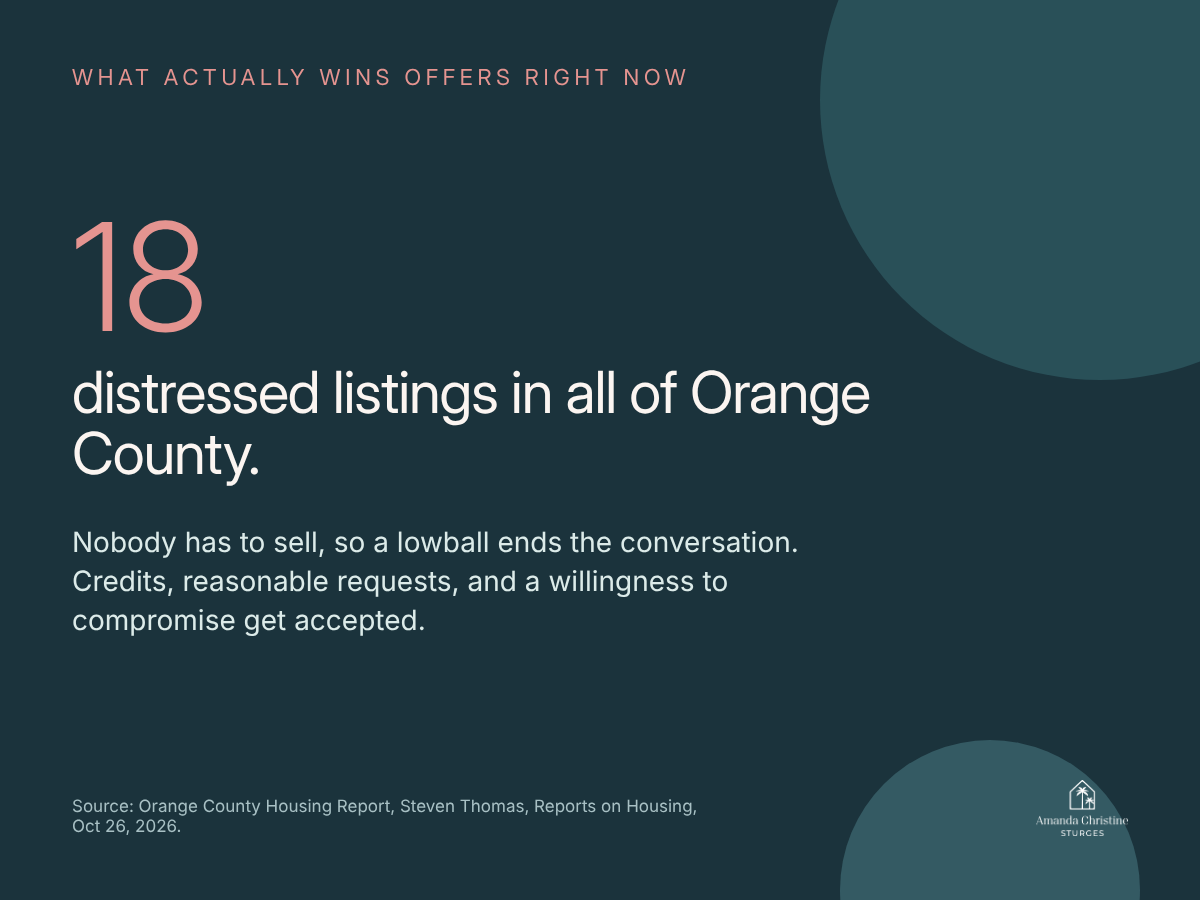
A lowball works on a seller who has to sell, and Orange County has very few of them. There are 18 distressed listings in the entire county, and 99.8% of September's sellers closed with equity. Most people listing a home here chose to, which means they can also choose to wait. Plenty are doing exactly that: 1,042 homes came off the market in September without selling, 37% more than a year earlier.
The slowdown is coming from buyers stepping back. Sellers aren't cornered, and that changes what an aggressive offer accomplishes.
What a low number does to a negotiation
Picture it from the seller's chair. They've lived in the house, maybe raised a family in it, and they've had a number in their head since the day it went live. An offer well below that number doesn't land as an opening bid. It lands as a loss, and people react to losses far more strongly than to gains of the same size. That's one of the most consistent findings in behavioral economics, and it plays out at the negotiating table constantly. The usual result is a seller who digs in, counters barely, or doesn't respond. The first number also tends to set the tone for everything after it, so an offer that opens as an insult usually stays one.
Now compare a buyer who offers close to a fair price and asks for a credit toward closing costs or a rate buydown. The dollars can end up surprisingly close to what the lowball was chasing. The difference is that the seller's sale price stays intact, the request reads as reasonable, and saying yes doesn't feel like losing. What I'm seeing win offers this fall is credits, reasonable requests, and real openness to compromise. A seller who feels respected starts looking for a way to make the deal work.
Where the real room to negotiate is
None of this means buyers lack leverage. They have it, and it's concentrated in specific listings. The new report breaks down September's closed sales by price history:
- 68% sold with no price cut, at full list price, in a median of 11 days.
- Homes with a 1% to 4% cut sold at about 96% of their original list price after 56 days.
- Homes with a cut of 5% or more sold at about 89% of their original list price after 81 days.
So the well-priced, move-in-ready homes are still selling quickly at full price, and a lowball on one of those mostly hands it to the next buyer. The homes that have been sitting, with a reduction or two in their history, are where the negotiating room is, and 45% of homes on the market have already cut their price at least once. Before you write a number, read the listing's price history. It tells you how much flexibility that seller has already shown.
The math on waiting for a discount
Steven Thomas raised a useful point in his latest Housing Debrief. If prices ease something like 2% over the next year, that decline happens gradually. Asking a seller to hand you the whole year's drop today means asking them to absorb it up front, while rates could move in either direction in the meantime. For most buyers, negotiating smart terms now is a better bet than trying to time the market.
If you're on the selling side
A low offer stings, especially after a few quiet weeks. Before you react, measure it against your comps, your home's condition, and your showing traffic, because one aggressive offer is one buyer's strategy, not the market's verdict on your home. If the showings are steady and offers aren't coming, that's worth a pricing conversation. And when a fair offer arrives with a request for credits, give it serious thought. It's often the cleanest path to the closing table.
Where this leaves us
My October message still applies to both sides: move when your life calls for it, and go in with a strategy. Right now the strategy that works is a fair price, smart terms, and some flexibility, which also happens to be the approach that keeps both parties at the table.
Updates
October 28, 2026: Published with numbers from the Orange County Housing Report "The Power of Pricing" (Oct 26), Housing Debrief S7E41 (Oct 23), and NAR's September 2026 data. I'll update this post as the next reports come in.
Questions about a specific home, your own numbers, or an offer you're weighing? Call me at (949) 257-2276 or Book a Virtual Meeting.
Sincerely,
Amanda Christine Sturges, Realtor® DRE #02348474 · Coldwell Banker Realty
Sources: Orange County Housing Report, "The Power of Pricing," October 26, 2026, Steven Thomas, Reports on Housing (reportsonhousing.com); Housing Debrief S7E41, "Housing's Reality Check," Reports on Housing, October 23, 2026 (youtube.com/watch?v=-pzFzfGOHkM); National Association of Realtors, September 2026 pending home sales and existing-home sales data (nar.realtor); Kahneman, D., and Tversky, A., "Prospect Theory: An Analysis of Decision under Risk," Econometrica, 1979; Tversky, A., and Kahneman, D., "Judgment under Uncertainty: Heuristics and Biases," Science, 1974. Analysis and opinions are my own. Nothing here is financial advice; your lender and your own budget get the final word.
